Marine vessels and offshore operating platforms operate persistently under harsh working conditions featuring high humidity, heavy salt spray, mold growth, alternating temperature cycles, together with multiple external loads such as hull swaying, continuous vibration and sea‑water splashing. Even when fitted with simple waterproof enclosures, ordinary land‑based motors cannot resist chloride‑ion corrosion and internal condensation in marine environments. They are prone to failures including insulation degradation, metallic corrosion, bearing seizure and short‑circuit shutdown, which pose direct threats to vessel power and operational safety. Marine‑use motors must satisfy special marine specifications in terms of electrical performance, protection and sealing, insulation and anti‑corrosion, mechanical structure, environmental testing and marine certification to guarantee long‑term stable equipment operation. Drawing on domestic GB/T standards, CCS Classification Society rules and IEC international marine electrical standards, this paper sorts out mandatory performance indicators and technical requirements for marine‑use motors deployed in high‑humidity offshore conditions.
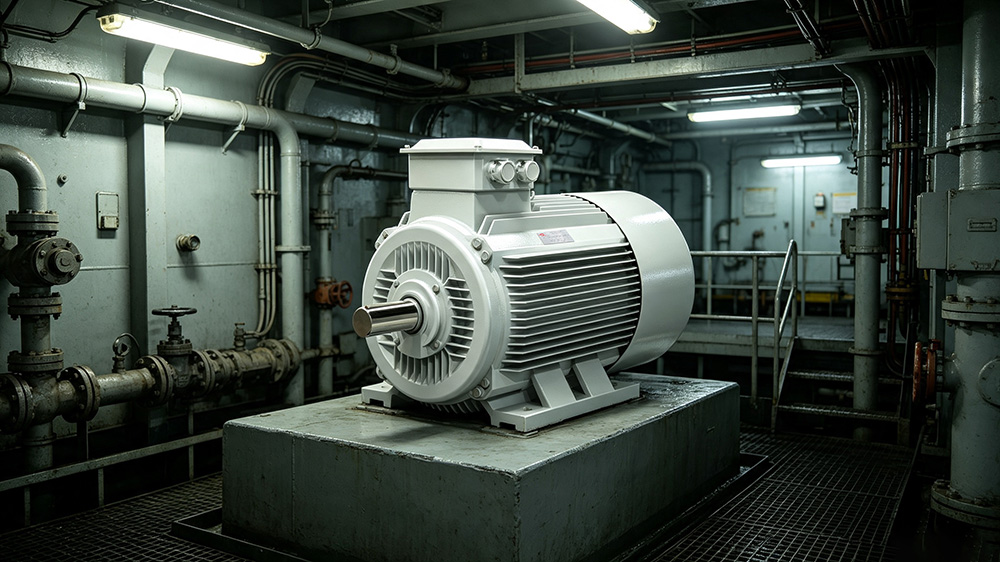
I. Primary Damage Mechanisms of Marine High‑Humidity Environments to Motors
Damage inflicted by offshore environments on motors arises from the coupling of multiple factors, with four core risk categories highlighted below.
First, hazards induced by high‑humidity condensation. The relative humidity of offshore air can reach as high as 95%. Diurnal temperature variations and start‑stop cycles generate condensed water inside motor cavities. Moisture adhering to winding surfaces rapidly reduces insulation resistance and triggers creepage and inter‑turn short‑circuits. Condensate trapped in bearing chambers and terminal boxes accelerates grease emulsification and failure as well as oxidation and corrosion of terminals.
Second, electrochemical corrosion caused by salt spray. Chloride ions carried in sea wind exhibit strong penetration capacity, resulting in pitting corrosion on enclosures, seized fasteners, blistering and peeling of housing coatings, and crevice corrosion at metallic joints. This damages sealing structures and further facilitates moisture ingress into motor interiors.
Third, synergistic aging induced by mold and oil mist. Under high‑humidity conditions, mold grows on the surface of insulating materials and degrades insulating paint films. Oil mist mixed with water vapor in engine rooms adheres to components, blocks heat dissipation channels and accelerates material deterioration.
Fourth, compound damage from sway and vibration. Sustained hull vibration and tilting sway loosen seals and dislodge wiring terminals, widening ingress pathways for moisture and salt spray and aggravating various failure risks stemming from humid conditions.
II. Enclosure Protection, Sealing and Drainage Performance Requirements
Enclosure protection serves as the first barrier blocking high‑humidity seawater and salt spray from penetrating motor interiors. Applicable standards include GB/T 4942.1 and GB/T 7060‑2019 Basic Technical Requirements for Marine Rotating Electrical Machines.
Protection‑grade selection
For motors installed in ventilated in‑hull machinery spaces, the minimum protection grade shall be IP54. For deck‑mounted, open‑air equipment subject to sea‑water splashing, a protection grade of IP56 or higher shall be adopted. IP65 or IP67 shall be specified for working conditions with direct seawater washing. The protection grade of terminal boxes shall not be inferior to that of the motor main body, with a minimum rating of IP44. Special marine cable gland fittings shall be equipped to prevent water seepage and moisture backflow at cable entry points.
Internal cavity drainage structure
Motors intended for high‑humidity offshore service shall be fitted with bottom drain holes to evacuate condensed water accumulated inside the motor. Drain holes shall be positioned at the lowest installation point of the complete unit to avoid condensate pooling inside the housing. Drain holes shall remain unobstructed during shutdown, and sealing plugs may be deployed for operation‑mode use to balance protection and water‑drainage functions.
Sealing‑structure design
Marine‑environment‑resistant rubber seals made of salt‑spray‑resistant and aging‑resistant nitrile rubber or fluororubber shall be adopted for mating surfaces of end covers, frames and terminal boxes, so as to avoid rapid aging and failure of ordinary rubber exposed to seawater. Multiple water‑throwing rings and labyrinth seals shall be arranged at shaft extensions to block seawater and water mist from invading bearing chambers and internal housings along shaft gaps.
III. Insulation System and Anti‑Moisture & Anti‑Condensation Performance
Winding insulation represents the primary threat under humid conditions, and the insulation system constitutes the core of marine‑use motor reliability. Relevant references include GB/T 7061 Technical Conditions for Marine Asynchronous Motors and IEC 60092‑301 Electrical Installations in Ships‑Part 301: Motors.
Insulation thermal class
F‑class (155 °C) insulation systems are preferred for marine‑use motor windings. H‑class (180 °C) insulation may be selected for heavy‑duty equipment in high‑temperature enclosed engine rooms or offshore platforms. Beyond temperature‑rise tolerance, insulating materials must deliver resistance to humidity‑heat, salt spray and mold. Windings shall undergo vacuum‑pressure impregnation to achieve dense, intact paint films, block moisture penetration into gaps of magnet wires and mitigate insulation‑resistance attenuation caused by dampness.
Insulation‑resistance indicators
Cold‑state insulation resistance shall generally be no less than 50 MΩ. Under hot operating conditions, insulation resistance shall remain above 10 MΩ. After humidity‑heat testing under 95‑percent high‑humidity environments, insulation performance shall not drop sharply, and no inter‑turn or earth‑fault breakdown shall occur.
Built‑in anti‑condensation heating devices
Marine‑use motors shall be equipped with anti‑moisture heating strips. Heaters are activated during motor shutdown to raise internal cavity temperature and prevent internal condensation induced by cold‑hot alternation. Heater power shall match motor frame size without causing local overheating. Winding temperature sensors shall interlock with heating devices to fundamentally resolve shutdown‑related condensation, a key configuration distinguishing marine motors from general‑purpose industrial motors.
Mold‑resistance performance
Insulating varnishes and internal non‑metallic components shall comply with marine mold‑resistance requirements and pass mold‑growth tests to suppress mold propagation under high‑humidity conditions and prevent mycelium‑induced damage to insulating surface layers.
IV. Anti‑Corrosion Materials and Coating‑System Performance
In high‑humidity salt‑spray offshore environments, enclosure protection alone cannot fully block trace salt‑spray permeation. Bulk materials and anti‑corrosion coating systems constitute the second‑line defence. Reference standards cover ISO 12944 Marine Anti‑Corrosion Standards and GB/T 2423.17 Salt‑Spray Test Method.
Material selection for enclosures and fasteners
All exposed fasteners shall be manufactured from stainless steel to avoid corrosion and seizure of ordinary carbon‑steel bolts. Wiring terminals and conductive copper components shall be tin‑plated or silver‑plated for anti‑corrosion purposes, preventing increased contact resistance and terminal ablation caused by high‑humidity salt‑spray exposure. All cast‑iron frame surfaces shall receive anti‑corrosion treatment to mitigate substrate‑corrosion risks.
Heavy‑duty anti‑corrosion coating systems
Motors for open‑air deck deployment shall adopt C5‑M marine heavy‑duty anti‑corrosion coating systems, typically consisting of zinc‑rich epoxy primer, epoxy micaceous iron intermediate paint and marine‑weather‑resistant topcoat with sufficient total dry‑film thickness. Coatings shall pass salt‑spray assessment with a minimum neutral salt‑spray test duration of 168 hours. No blistering, peeling or severe pitting corrosion shall occur to withstand long‑term chloride‑ion attack.
Selection of non‑metallic components
Sealing rings, fan blades and internal insulating parts inside terminal boxes shall be fabricated from seawater‑resistant and humidity‑heat‑aging‑resistant materials. Ordinary plastics prone to swelling and cracking under high‑humidity exposure shall not be used.
Stay tuned for the next installment for more knowledge on marine‑use motors.