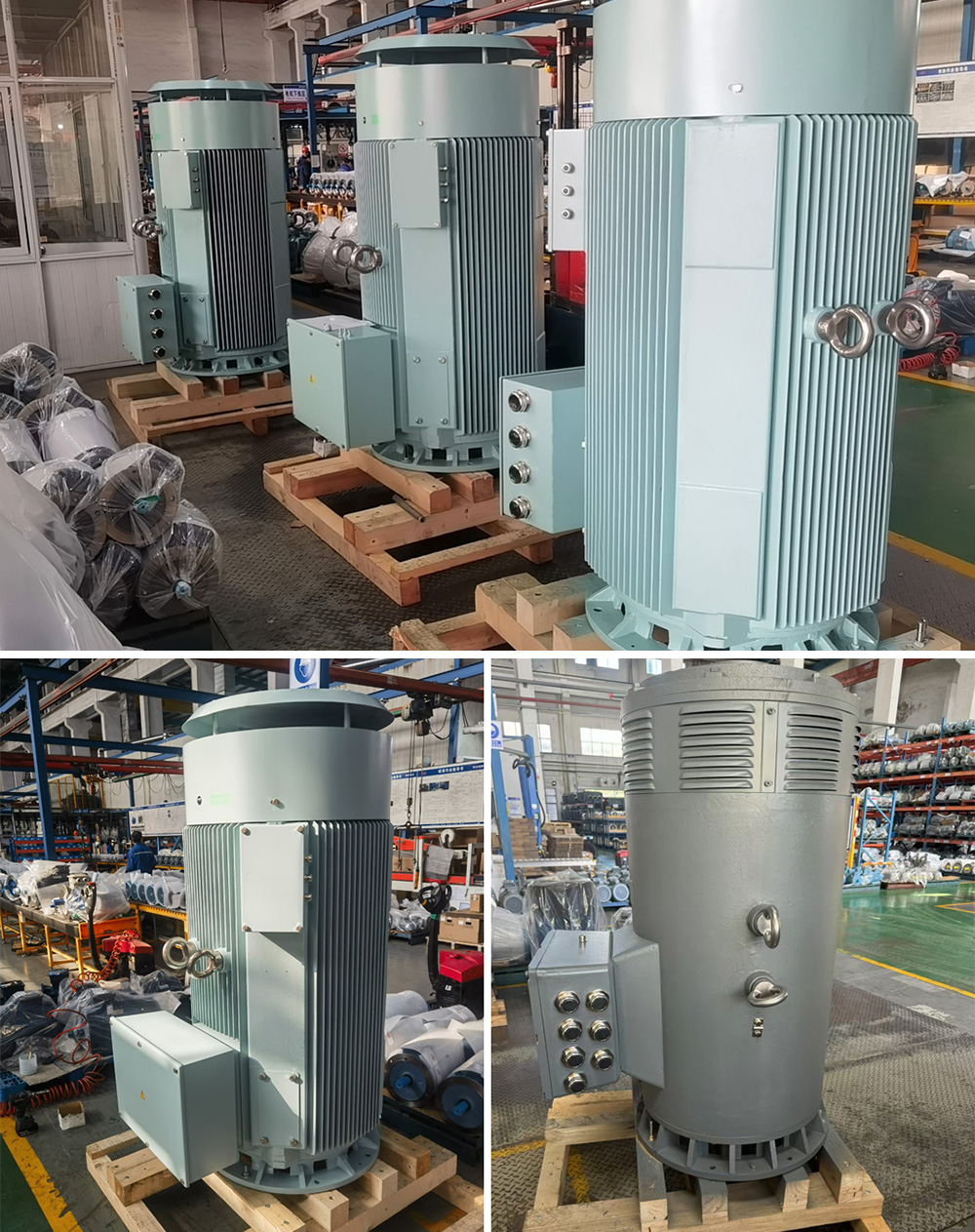
Key Performance and Standard Requirements for Marine‑Use Motors in High‑Humidity Offshore Environments (Part II)
V. Mechanical Performance: Adaptation to Hull Tilting, Swaying and Vibration Shock
Sustained sway, tilting and vibration occur during vessel navigation. Under high‑humidity conditions, vibration can damage seals and accelerate corrosion. Marine‑use motors shall comply with marine mechanical environmental conditions in accordance with CCS rules and IEC 60068 environmental‑testing standards.
Operation capability under tilting and swaying
Motors shall be capable of long‑term continuous operation at static tilt of 15° and dynamic sway of 22.5°. The lubrication system and bearing oil supply shall remain unaffected by sway; grease shall not leak or escape, and no abnormal temperature rise or oil leakage shall occur.
Vibration and shock resistance
Motors shall withstand continuous vibration and short‑term shocks induced by main engines and sea waves. Rotor dynamic balance grade shall meet marine requirements. Internal windings shall be securely bound and wiring firmly fastened against loosening caused by vibration. Reinforced base structures shall be adopted for complete units to avoid resonance. For variable‑frequency marine‑use motors, bearing insulation shall be provided to suppress shaft current, prevent bearing corrosion caused by shaft current and extend service life under offshore operating conditions.
Power margin design
A 10%‑15% power margin is recommended for offshore working conditions to compensate for extra loads brought by sway‑induced resistance and degraded heat dissipation, and avoid aggravated temperature rise and insulation aging resulting from long‑term motor overload.
VI. Environmental Simulation Test Items
Apart from conventional electrical‑performance tests, type tests for finished marine‑use motors must include special marine‑environment tests to verify adaptability to high‑humidity offshore conditions. Major test items are listed below:
Alternating damp‑heat test: Simulates diurnal temperature‑humidity cycles at sea. Cyclic damp‑heat testing evaluates resistance to damp aging of complete‑unit insulation, seals and non‑metallic components, with reference to IEC 60068‑2‑30.
Neutral salt‑spray test: Simulates marine salt‑spray atmosphere to assess salt‑spray corrosion resistance of enclosure coatings, fasteners and terminals, complying with GB/T 2423.17.
Tilting‑sway test: Simulates vessel heel and roll to evaluate lubrication performance, sealing performance and overall operational stability.
Vibration and shock test: Simulates hull vibration and shock to check for loosening or damage of internal structures and wiring connections.
Enclosure protection test: Verifies IP‑grade water‑ and dust‑proof performance, and validates effectiveness of sealing and drainage structures.
VII. Electrical Performance, EMC and Marine‑Classification‑Society Certification Requirements
Electrical adaptability to marine power grids
Motors shall adapt to common marine voltage ratings of 380 V and 440 V, at 50 Hz / 60 Hz. Motors fed by variable‑frequency power supplies shall withstand high‑frequency dv/dt impacts from converters; inter‑turn insulation of windings shall be reinforced to restrain extra temperature rise caused by harmonics. Embedded temperature sensors shall be fitted in windings of high‑voltage marine‑use motors for over‑temperature alarm and protection.
Electromagnetic Compatibility (EMC)
Compliance with IEC 60533, the EMC standard for marine electrical equipment. Within narrow confined onboard spaces, electromagnetic disturbance from motors shall not interfere with ship‑borne navigation, communication and control systems, and adequate immunity performance shall be guaranteed.
Access via marine‑classification‑society certification
Motors installed on domestic vessels shall obtain the Type Approval Certificate issued by China Classification Society (CCS). For ocean‑going export vessels, compliance with requirements of classification societies such as DNV and ABS is also acceptable, together with relevant provisions of the SOLAS Convention (International Convention for the Safety of Life at Sea). Ordinary industrial motors without classification‑society approval are not permitted for direct onboard installation. Even with subsequent waterproof retrofitting, they cannot pass comprehensive environmental assessment for offshore high‑humidity and salt‑spray conditions.
VIII. Key Points for Selection and Application
Misconceptions exist in many projects, where land‑based IP56 motors with additional protective hoods are directly substituted for genuine marine‑use motors. Land‑based motors are not equipped with anti‑condensation heaters, vacuum‑pressure impregnated windings, salt‑spray anti‑corrosion treatments or validated sway‑vibration resistance. Relying merely on enclosure protection cannot block internal condensation and trace salt‑spray ingress. When operated in high‑humidity offshore environments for several months, such motors tend to suffer insulation degradation and corrosion failures.
During equipment selection, distinguish between installed locations: inner machinery spaces versus open‑air decks, and select appropriate protection grades accordingly. Priority shall be given to motors fitted with anti‑moisture heaters, bottom drain structures and marine‑grade insulation of Class F or higher. In maintenance and operation, regularly check drain holes for smooth flow; ensure anti‑moisture heaters work properly during shutdown periods; periodically measure insulation resistance so as to detect damp‑related risks in a timely manner.
Conclusion
Marine‑use motors for high‑humidity offshore service are not simply ordinary motors upgraded with waterproofing measures. Instead, they require dedicated full‑system design covering protection‑sealing, anti‑condensation insulation, heavy‑duty anti‑corrosion materials, sway‑vibration resistance, environmental simulation testing and marine‑classification‑society certification. Given the coupled effects of salt spray, high‑humidity condensation, mold and hull vibration, deficiency in any link will lead to premature motor failure. Type‑selection and inspection shall be strictly implemented in accordance with standards including GB/T 7060, CCS rules and IEC 60092‑301, so as to ensure safe and reliable operation of power systems for vessels and offshore installations.
Should you require, I can condense this article into a technical‑scheme abstract, or compile a checklist of marine‑use motor technical parameters for tendering and technical‑agreement drafting.
Hengda Motor has long focused on R&D, manufacturing and services for marine‑use motors. Supported by advanced technologies and equipment, lean manufacturing processes, reliable product quality and satisfactory after‑sales services, the company provides customers with optimal professional motor solutions and strives to create greater social value.